

Capital, Technology, and Trust: The Three Pillars Defining the Next Era of Financial Leadership
By Mr. Yatrik Vin
Founder, Nexora Insights · Former Group CFO & Head Corporate Affairs, National Stock Exchange of India
Over a career spanning more than three decades at the heart of India’s capital markets — the last twenty-three of those as Group CFO and Head of Corporate Affairs at the National Stock Exchange of India — I have witnessed financial leadership evolve through several distinct phases. From the manual settlement era, through technology-led market infrastructure modernisation, to today’s data-driven, AI-augmented enterprise — each transition has demanded not just new tools, but an entirely new conception of what it means to lead a finance organisation.
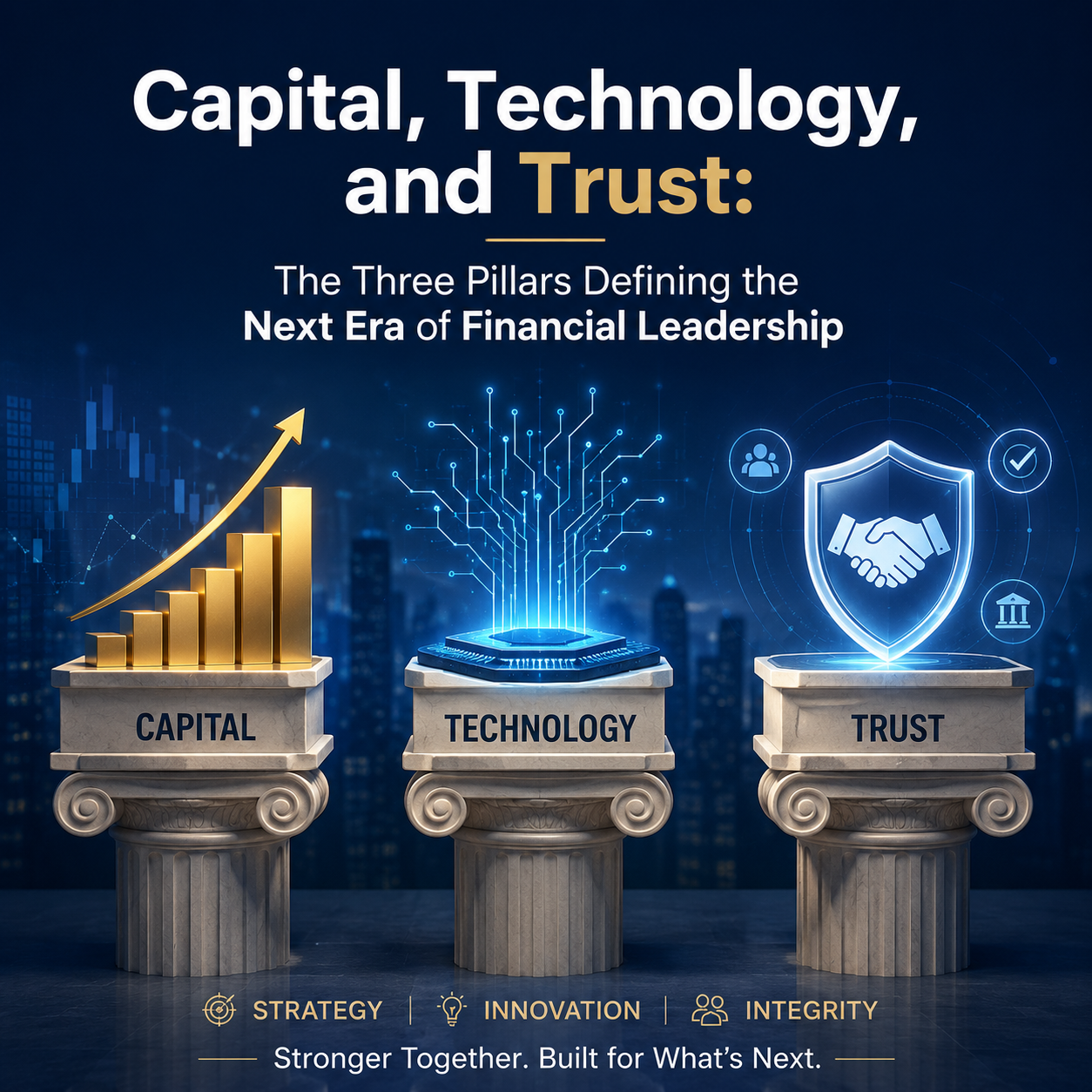
What I have come to believe — and what the evidence of the past decade confirms emphatically — is that the next era of financial leadership will be defined not by any single capability, but by the integration of three interdependent pillars: Capital, Technology, and Trust. Organisations that build genuine institutional strength across all three will define the competitive landscape. Those that pursue one or two in isolation will find that the missing pillar becomes their most consequential vulnerability.
“In the modern enterprise, financial leadership increasingly means managing not just capital, but complexity — and doing so with speed, precision, and adaptability.”
Pillar 1 — Capital: Beyond Liquidity Management
Capital has always been the CFO’s primary domain. But the conception of capital management has changed fundamentally. In earlier decades, the mandate was straightforward: maintain liquidity, manage cost of capital, and ensure the balance sheet could withstand operational shocks. These remain necessary conditions. They are no longer sufficient ones.
During my career overseeing capital strategy across a highly diversified financial services ecosystem, I witnessed firsthand the challenges of balancing regulatory requirements, growth ambitions, and enterprise resilience across multiple interconnected institutions. Each entity had distinct capital needs, regulatory capital requirements, and risk profiles. The challenge was not managing capital in isolation for each — it was architecting an integrated capital framework across sixteen institutions that collectively formed India’s financial market infrastructure.
What that experience taught me is that genuine capital leadership operates across four dimensions that are deeply interconnected:
- Liquidity — ensuring that every entity in the group can meet its obligations under both normal and stressed conditions, without relying on emergency capital from the parent.
- Resilience — building capital buffers that are not merely regulatory minimums, but strategically calibrated to the actual risk exposures of the business, including tail risks that standard models underestimate.
- Capital Efficiency — deploying capital to its highest-return uses across the group, ensuring that idle capital does not accumulate in subsidiaries while core operations face constraints.
- Strategic Allocation — using capital as an instrument of strategy, not just a treasury function. Every significant capital decision — whether a new subsidiary, a strategic investment, or a market expansion — is ultimately a statement about where the organisation believes value will be created.
The practical implication for organisations today is that capital management must be integrated upward into board strategy and downward into operational decision-making. CFOs who treat capital as a financial hygiene exercise — rather than as the organisation’s most consequential strategic lever — will find themselves consistently behind the curve when opportunities arise or crises emerge.
Capital Under Pressure and Opportunity
When NSE navigated its transition toward becoming a global exchange — pursuing international listings, expanding into commodity derivatives, and establishing NSE IFSC at GIFT City — capital was not merely a constraint to manage. It was the enabler of an institutional ambition. Ensuring that we had the capital structure to support each of these initiatives, while maintaining the regulatory capital requirements of a systemically important market infrastructure institution, required a level of strategic capital planning that went far beyond traditional treasury management.
I recall periods where the market structure was shifting rapidly — new regulatory requirements, shifting competitive dynamics, and the need to invest in technology infrastructure simultaneously. In those moments, the quality of our capital planning — the reserves we had built, the relationships with regulators we had maintained, the transparency we had built with our investor community — was the difference between being able to seize opportunity and being forced to manage defensively. That experience has deeply shaped my conviction that capital resilience is not a passive financial state. It is an active strategic choice.
Pillar 2 — Technology: From Digitisation to Intelligence
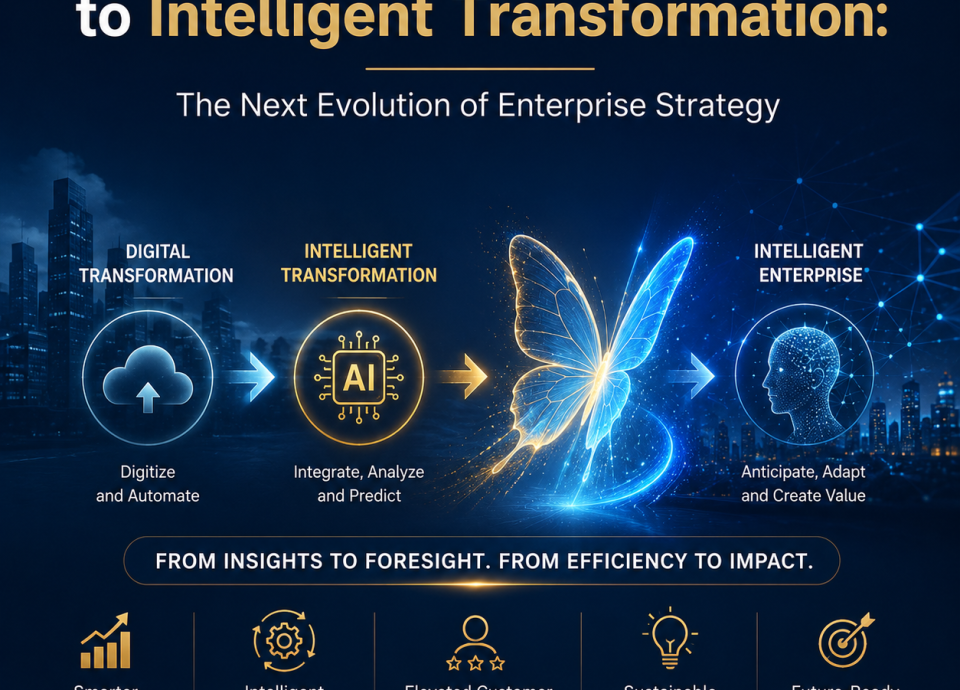
There is an important distinction that I find is frequently lost in conversations about enterprise technology: the difference between digitisation and intelligence. Most organisations that claim to have undergone digital transformation have, in reality, digitised their existing workflows — they have moved paper processes onto screens, manual approvals into electronic workflows, and physical files into cloud storage. This is valuable. It is not transformative.
True intelligent transformation — which I believe is the real frontier — means changing how decisions are made, not just how information is stored. It means deploying AI not to automate existing processes but to enable decisions that were previously impossible: predicting capital market movements with greater precision, identifying risk concentrations before they become crises, allocating treasury assets dynamically based on real-time market signals rather than static models.
The four dimensions of technology that I believe every enterprise finance leader must now own — not delegate to the CTO — are:
- AI-driven operations — using machine learning not just for reporting, but for anomaly detection, fraud prevention, and real-time financial risk monitoring across complex multi-entity group structures.
- Integrated finance systems — connecting disparate ERP, treasury, risk, and reporting systems into a unified financial data architecture that provides a single source of truth across the organisation.
- Predictive analytics — moving from backward-looking financial reporting to forward-looking scenario modelling that can stress-test the balance sheet against multiple macro environments simultaneously.
- Digital operating models — redesigning finance processes from the ground up with technology at the core, rather than retrofitting digital tools onto analogue workflows.
Technology as Critical Infrastructure
In large-scale financial market infrastructure environments, technology is not a support function — it is the core operating foundation. The exchange’s ability to execute trades at microsecond latency, process hundreds of millions of transactions daily, and maintain the integrity of India’s financial market infrastructure was entirely dependent on technology. As Group CFO, this meant that my capital allocation decisions directly shaped the technology investments that determined NSE’s competitive position.
One of the most consequential leadership decisions I was involved in concerned a large-scale upgrade of mission-critical market infrastructure — a programme that required significant capital, regulatory coordination, and sustained board-level commitment. The case for investment was not simply operational efficiency. It was about building the technology foundation that would allow the exchange to operate as a globally competitive exchange — one that international investors and listed companies could rely upon with absolute confidence.
That experience sharpened my perspective in a way that I now bring to every Nexora Insights engagement: technology investment in financial services is never just a technology decision. It is a capital decision, a risk decision, a regulatory decision, and a competitive strategy decision — all simultaneously. Finance leaders who treat technology as someone else’s problem will increasingly find that they have outsourced one of their most powerful strategic levers.
“The CFOs who will define the next decade are those who understand that every technology decision is a capital allocation decision — and every capital allocation decision has a technology implication.”
Pillar 3 — Trust: The Foundation That Everything Else Rests Upon
Of the three pillars, Trust is the one most frequently underestimated — and, paradoxically, the one whose absence is most catastrophic. Capital can be rebuilt. Technology can be upgraded. Trust, once damaged at an institutional level, can take a generation to restore.
Trust in the context of enterprise financial leadership operates across five dimensions that must all be actively cultivated — not assumed:
- Governance — the architecture of accountability within the organisation: how decisions are made, who has authority over what, how conflicts of interest are managed, and how the board exercises genuine rather than ceremonial oversight.
- Compliance — not merely the avoidance of regulatory penalties, but the embedding of ethical and legal standards into the operating culture of the organisation, so that compliance is a reflex rather than a checklist.
- Cybersecurity — in an era where financial institutions are primary targets for sophisticated cyber actors, the integrity of financial systems and data is inseparable from institutional trust. A single material breach can permanently alter stakeholder confidence.
- Transparency — the willingness to communicate openly with investors, regulators, employees, and the public about the organisation’s financial position, strategy, and risk exposures — including when the news is difficult.
- Institutional Credibility — the accumulated reputational capital that an organisation builds over years of consistent, principled behaviour. It is this credibility that determines whether regulators give you the benefit of the doubt, whether institutional investors extend their confidence during periods of volatility, and whether talent chooses your organisation over competitors.
These five dimensions of trust are not independent. They are deeply interconnected — and they compound. Organisations with strong governance build stronger compliance cultures. Strong compliance cultures attract higher-quality talent. Higher-quality talent builds more resilient technology. And resilient technology enables the transparency that deepens institutional credibility. The virtuous cycle, when genuinely embedded, becomes a durable competitive moat.
Trust as a Competitive Advantage
The clearest demonstration of institutional trust as competitive advantage that I witnessed was in how the exchange navigated periods of extreme market stress — the global financial crisis, the COVID-19 market shock, and several episodes of significant domestic market volatility. In each instance, the decisions made at the board and management level about transparency, communication with regulators, investor relations, and market integrity were not just ethical choices. They were strategic choices with measurable market consequences.
During the COVID-19 crisis in March 2020, when global markets experienced some of the most violent volatility in recorded history, our market infrastructure continued to function with integrity precisely because the governance, risk, and technology systems were not assembled in response to the crisis — they had been built and tested over years. The trust of market participants — from individual retail investors to the largest institutional funds — was not a marketing claim. It was demonstrated through operational performance in the most challenging possible conditions.
As Group CFO during that period, managing investor communication, regulatory coordination, and the financial resilience of the group simultaneously under extraordinary pressure reinforced for me that trust is not an intangible asset. It has a very concrete balance sheet value — measured in the cost of capital, the depth of institutional support, and the speed of recovery when difficulties arise.
The Integrated Enterprise Trust Model: Connecting the Three Pillars
What I have described above as three separate pillars is, in practice, a single integrated framework that I now call the Integrated Enterprise Trust Model. The insight that ties all three together is this: Capital without Governance is reckless. Technology without Trust is dangerous. And Trust without Capital is unsustainable. The only durable competitive position is one where all three are built together, as an integrated system.
For enterprise leaders and boards attempting to operationalise this framework, I would suggest beginning with three diagnostic questions:
- Does your capital strategy explicitly account for the technology investments required to protect and sustain it — and does it reflect the reputational risks that could impair it?
- Are your technology investments evaluated not just for operational efficiency, but for their implications for institutional trust — including cybersecurity risk, data governance, and algorithmic accountability?
- Does your governance framework actively reinforce the behaviours that build long-term institutional credibility — or does it merely prevent the most obvious compliance failures?
Organisations that can answer yes to all three are building something genuinely durable. Those that cannot — regardless of their current financial performance — are accumulating structural vulnerabilities that will eventually surface.
“Capital, Technology, and Trust are not three separate management disciplines. They are three faces of the same institutional imperative: building an organisation that can be trusted with complexity, and that earns the right to grow.”
The Path Forward
As I reflect on what twenty-three years at the apex of India’s most important financial institution taught me, and as I now counsel organisations across sectors and geographies through Nexora Insights, I am struck by how consistently the organisations that navigate complexity most successfully are those that have been most intentional about building strength across all three pillars — simultaneously, not sequentially.
The temptation to build capital strength first, invest in technology second, and attend to governance last is understandable. It feels logical. But it is a sequencing error with serious consequences. The organisation that builds capital without governance attracts the wrong investors and makes the wrong decisions with their capital. The organisation that invests in technology without trust infrastructure finds that its digital systems become liabilities rather than assets. And the organisation that focuses on governance without genuine capital and technology foundations finds itself governing a declining enterprise with impeccable documentation.
The next era of financial leadership belongs to those who understand that Capital, Technology, and Trust are not three sequential priorities — they are three simultaneous commitments. The leaders and boards who make that commitment — and sustain it through the inevitable pressures of short-term performance — will build the institutions that define the next decade of economic life.
Mr. Yatrik Vin is Founder of Nexora Insights and former Group CFO & Head Corporate Affairs at the National Stock Exchange of India. He held directorships across 16 institutions including NSE IFSC, NSE Clearing, Power Exchange India, NSE Sustainability Ratings & Analytics, and the Institute of Social Auditors of India. He is a recipient of the Best CFO of the Year 2014 (ABP News BFSI Awards) and Most Influential CFO of India (CIMA, UK).