

The Next Evolution of Enterprise Strategy
By Mr. Yatrik Vin
Founder, Nexora Insights · Former Group CFO & Head Corporate Affairs, National Stock Exchange of India
There is a question I am asked with increasing frequency by CEOs, CFOs, and boards across India and beyond: we have invested heavily in digital transformation over the past decade — so why does our organisation not feel fundamentally more capable? Why do our decision cycles still feel slow? Why does the data we have invested so much in producing not seem to give us a decisive competitive advantage?
The answer, in my experience, is that most organisations have confused digitisation with transformation. They have digitised the surface of their operations — moved workflows onto screens, migrated data to cloud platforms, automated routine reporting — while leaving the core of how decisions are made entirely unchanged. They have invested in digital infrastructure without investing in decision infrastructure. And the gap between those two things is where the most significant value creation opportunity of the next decade now sits.
I call this next frontier Intelligent Transformation — and it represents a qualitatively different kind of organisational change than anything that has come before it.
“Most firms digitised their workflows. Very few transformed how decisions are actually made. That gap is the defining competitive frontier of the next decade.”
Why So Many Digital Transformations Failed to Deliver
To understand where we need to go, it is worth being honest about why so many digital transformation programmes — despite enormous capital investment and genuine executive commitment — delivered disappointing returns. In my observation, across the organisations I have worked with and advised, the failures clustered around three systemic causes:
A. Technology without Strategic Integration
The most common failure mode was the acquisition of technology capabilities without a coherent strategy for how those capabilities would change the organisation’s competitive position. Organisations invested in ERP upgrades, CRM platforms, data lakes, and robotic process automation — but each investment existed in relative isolation. The technology served the function that commissioned it, rather than serving the enterprise’s overarching strategic priorities.
At NSE, I observed this pattern in the broader Indian corporate landscape as India’s exchange ecosystem modernised through the 2000s and 2010s. The organisations that struggled most were those that treated technology as a procurement exercise — selecting the best platform available in each category — rather than as a system design exercise that began with the question: what decisions does this organisation need to make better, and what information architecture would enable those decisions?
The distinction matters enormously. A technology strategy built around decision improvement asks fundamentally different questions than one built around workflow automation. It asks: where are our worst decisions made? Where is information asymmetry costing us the most? Where is decision latency — the time between when a decision should be made and when it actually gets made — creating competitive disadvantage? Answering those questions well requires a depth of business understanding that most technology vendors cannot provide, and that too many internal technology teams have not been empowered to develop.
B. Disconnected Investments
The second failure mode was the accumulation of point solutions that, individually, may have been well-designed and well-implemented, but that collectively created a fragmented information architecture. The finance system could not speak to the risk system. The CRM could not feed the financial planning model. The data lake was full of data that no one had the tools — or the skill — to analyse.
This fragmentation was not merely a technical problem. It was a decision quality problem. When the information required to make a good decision lives in five different systems with no common data architecture, the practical effect is that decisions get made on the basis of whatever information is most readily available — rather than whatever information is most relevant. That is a structural bias toward bad decisions, embedded into the organisation’s operating model.
I observed this challenge firsthand in large-scale financial institutions expanding into new business lines — commodity derivatives, currency derivatives, interest rate futures — each of which had its own risk profile, regulatory framework, and data requirements. The pressure to move quickly meant that systems were often built to serve the immediate need rather than the long-term information architecture. The subsequent work of integration — of creating a unified view of risk, capital, and market position across all asset classes — was significantly more expensive and disruptive than building coherently from the outset would have been.
C. Lack of Governance for Technology
The third and perhaps most underappreciated failure mode was the absence of governance structures adequate to manage technology at the scale and complexity that modern digital programmes require. Boards approved capital budgets. Management delegated implementation to technology teams. And the critical middle layer — the governance that should have connected strategic intent to technology architecture to operational outcome — was either absent or inadequate.
As a member of sixteen boards across the NSE Group — including technology, data, and infrastructure entities — I had a firsthand view of how consequential good technology governance is, and how expensive poor governance is. The boards and management teams that most successfully navigated technology transformation were those that had developed genuine technology literacy at the governance level: not coding expertise, but the strategic and risk management capability to ask the right questions of technology leaders, evaluate proposals rigorously, and hold management accountable for outcomes rather than outputs.
The boards that struggled most were those where technology remained a black box that non-executive directors deferred to management on entirely. That deference, while understandable given the complexity of modern technology systems, effectively removed the most powerful check on strategic misalignment in technology investment.
Intelligent Transformation: A Different Paradigm
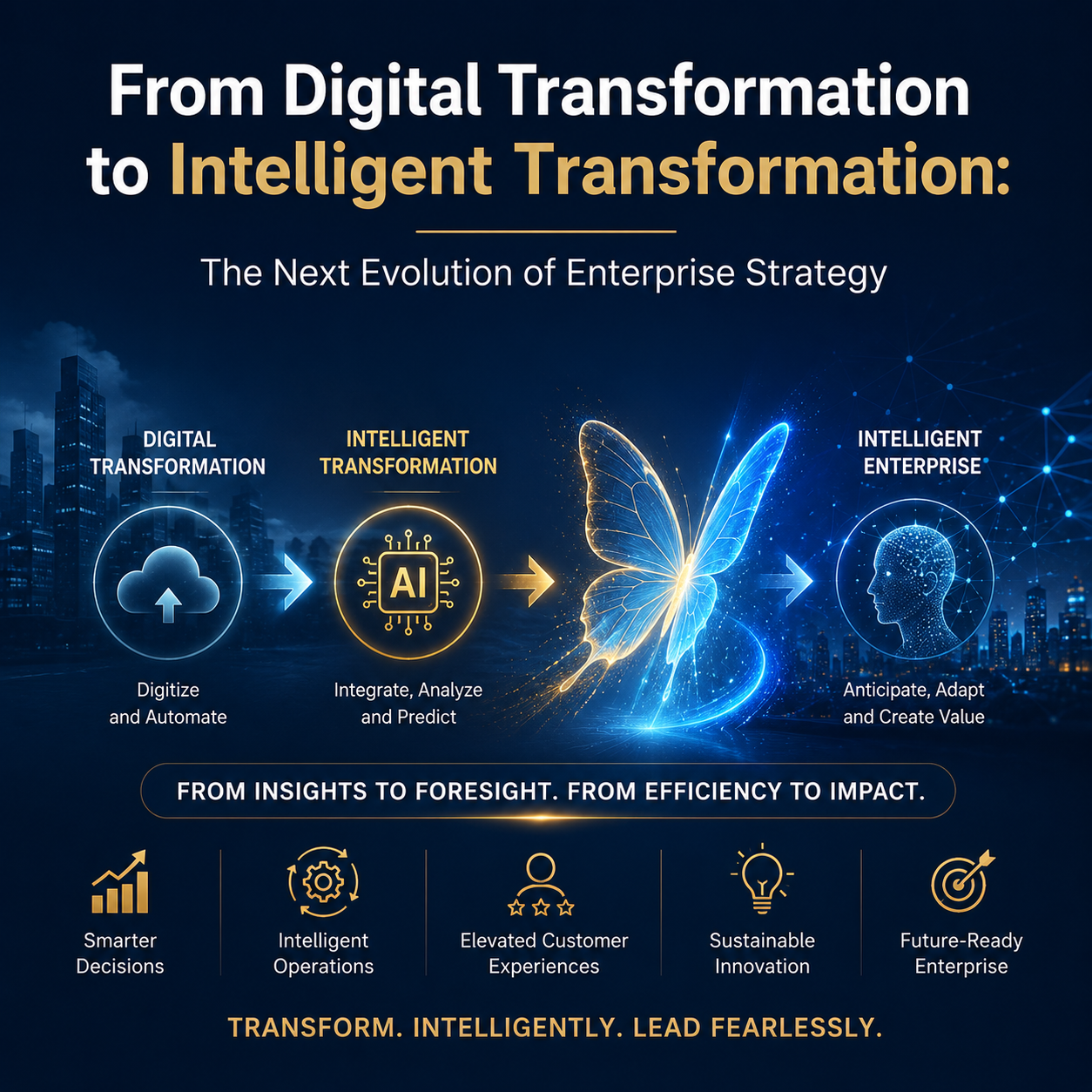
If the first wave of digital transformation was about digitising workflows, Intelligent Transformation is about augmenting judgment. It represents a fundamentally different theory of where technology creates value in an organisation.
The key distinction I draw — and that I believe separates organisations that are genuinely transforming from those that are merely digitising — is this: Most firms digitised workflows. Very few transformed decision-making itself. Intelligent Transformation operates at the decision layer, not the workflow layer. It asks: given all the information available to us, are we making the best possible decision as fast as possible — and are we learning from the outcomes of those decisions in a way that continuously improves the quality of future decisions?
AI-Driven Operations
The most visible dimension of Intelligent Transformation is the application of AI and machine learning to operational decision-making. But I want to be specific about what this means in practice — because the term AI is at risk of becoming so broadly used as to be analytically useless.
The AI applications that generate genuine competitive advantage are not the chatbots or the presentation automation tools that dominate public conversation. They are the anomaly detection systems that identify a developing credit risk before a human analyst could notice the pattern. They are the dynamic pricing models that adjust financial product parameters in real-time based on market signals. They are the capital allocation models that continuously re-optimise the deployment of treasury assets across instruments, maturities, and counterparties based on real-time risk and return data.
In advanced financial institutions, the use of AI for market surveillance — detecting manipulative patterns, identifying misconduct risks, and monitoring systemic vulnerabilities — is not a competitive luxury. It was a regulatory obligation and a market integrity imperative. But the discipline of building and governing those systems gave me a clear view of what genuine AI capability in a financial institution looks like, and how different it is from the AI theatre that many organisations are currently investing in.
Integrated Finance Systems
The second dimension of Intelligent Transformation is architectural: the creation of an integrated finance data architecture that eliminates the fragmentation I described earlier. This is not glamorous work. It does not generate press releases. But it is, in my view, the most consequential infrastructure investment that most finance organisations can make in the next five years.
An integrated finance system architecture means that every material financial event — a transaction, a market movement, a counterparty credit rating change, a regulatory capital calculation — flows into a single data model that is accessible to every system and every decision-maker that needs it. It means that the risk management team and the treasury team are looking at the same numbers at the same time. It means that the CFO’s view of the organisation’s financial position is not assembled from four different spreadsheets by a team of analysts over a weekend — it is available in real-time, at any level of granularity required.
The organisations I see making genuine progress on this front are not necessarily the ones with the largest technology budgets. They are the ones where the CFO has made data architecture a personal strategic priority — and where the board has endorsed that priority with appropriate capital allocation and governance attention.
The Nexora Methodology: A Strategic Transformation Framework
Based on my experience building and governing technology-intensive organisations at NSE, and my advisory work with diverse clients through Nexora Insights, I have developed a strategic transformation framework that I believe addresses the failure modes of first-generation digital transformation while capturing the opportunities of Intelligent Transformation.
The framework operates across four phases, each building on the one before:
- Strategic Clarity First — before any technology investment, establish with precision which decisions need to be improved, and what better decisions in those areas would be worth to the organisation. This sounds obvious. It is rarely done rigorously.
- Architecture Before Implementation — design the information architecture that would support those improved decisions before selecting any specific technology platform. Platform selection should follow architecture design, not precede it.
- Governance Integration — embed technology governance into board and management accountability structures from the outset. Not as a reporting layer added after implementation, but as a real-time accountability mechanism that connects technology performance to strategic outcomes.
- Continuous Learning Infrastructure — build the measurement and feedback systems that allow the organisation to learn from every decision made, and systematically improve decision quality over time. This is the dimension that converts digital investment into genuine intelligent transformation.
This framework is not a product or a proprietary methodology in the sense of a rigid process. It is a set of principles derived from watching — and in many cases personally navigating — the difference between technology investment that transforms and technology investment that disappoints. The common thread in every successful transformation I have observed is that it began with a clear and honest articulation of the decision problem being solved — and never let go of that articulation, even as implementation complexity grew.
“Every technology decision is ultimately a decision about how the organisation will think. The organisations that invest in better thinking — not just better processes — are the ones that build lasting competitive advantage.”
The Conclusion: Intelligent Enterprises Will Define the Next Era
I want to close with a perspective that I believe captures the strategic importance of what I am calling Intelligent Transformation. We are entering an era where the scarce resource in enterprise competition is not capital, not technology access, and not talent in the abstract sense. The scarce resource is the quality of judgment — the ability to make consistently better decisions, faster, across the full complexity of a modern enterprise operating in volatile global markets.
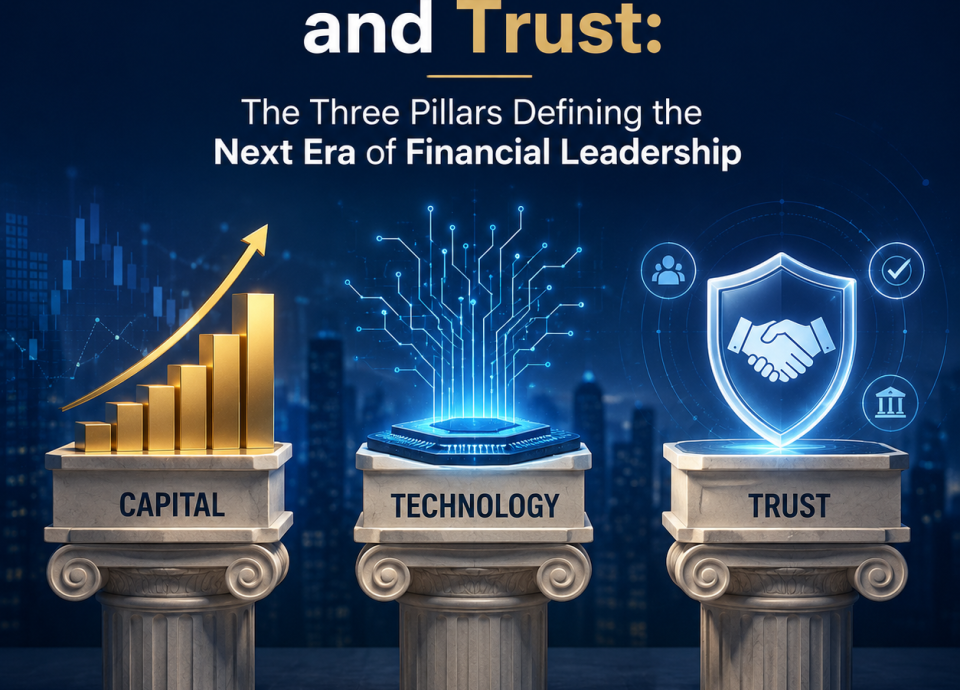
Capital is increasingly abundant. Technology platforms are increasingly commoditised. The organisations that will define the next era of economic competition are those that can navigate complexity more intelligently than their competitors — that can see patterns earlier, respond faster, learn more rapidly from outcomes, and deploy their resources with greater precision.
That capability — Intelligent Transformation — is not a technology project. It is an organisational transformation project that uses technology as its primary instrument. And like all genuine transformation, it requires leadership commitment that goes beyond approving a capital budget. It requires board-level conviction that the quality of organisational intelligence is a strategic priority worthy of sustained investment and governance attention.
The competitive advantage of the next decade will increasingly be earned not by the organisations with the most capital or the fastest technology, but by those that can manage complexity most intelligently. This is not a future state — it is the present reality for the most competitive organisations in global markets today. The question for every leadership team and board is whether they are building the institutional intelligence that will allow them to compete in that reality — or whether they are still digitising workflows and calling it transformation.
The time to make that distinction — and to act on it — is now.